How grading works
Graders read strike, high points and luster. See it on real coins, one idea at a time.
Five things a grader checks, shown on one real 1909 cent. Scroll to zoom in.
Grade my coin, freeWhat a grader actually looks at.
- The whole coinA 1909 Lincoln cent with the designer's V.D.B. initials, photographed for the Smithsonian's National Numismatic Collection.
- The strikeA strong strike leaves the letters and digits crisp, with square edges. A weak one leaves them soft and rounded.
- The high pointsHair, cheekbone and jaw stand tallest, so they wear first. Graders read them before anything else.
- The initialsV.D.B., for designer Victor David Brenner, sat on the reverse rim only in 1909. They returned, smaller, on Lincoln's shoulder in 1918.
- The lusterOn an uncirculated coin, light rolls around the fields like a cartwheel as the coin turns. Wear and cleaning break that roll.


Every coin gets the same light.
The grader studies your coin the way a dealer does under a lamp: luster on the fields, wear on the high points, color in the recesses. Here is what that light shows.
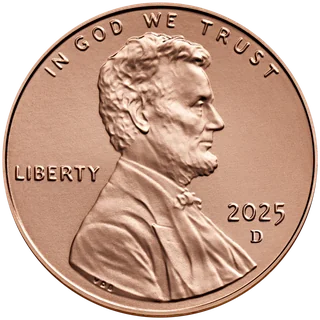
Mint redFull original color and untouched high points. A 2025-D cent, U.S. Mint photo. 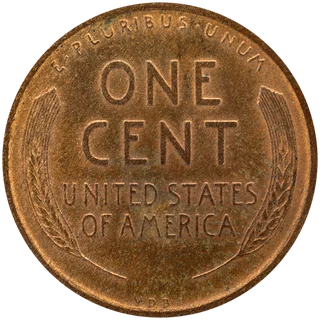
The reverse tellsWheat-ear lines and rim marks often decide the grade. A 1909 V.D.B. reverse, Smithsonian photo. 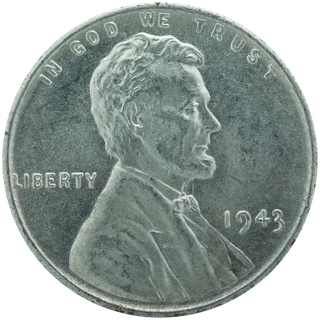
Right year, other metalA 1943 cent should be steel: a magnet lifts it. A bronze 1943 is a rare error. Smithsonian photo.


Watch a 1909-S VDB wear down from MS-65 to G-4.
Graders read the high points first. On a Lincoln cent that's the cheekbone, the jaw and the hair above the ear. ScrollSwipe to wear the coin and watch the value fall.
The coin is a real 1909-S VDB photo (Lost Dutchman Rare Coins, CC BY-SA 3.0 US); the wear is simulated on it for illustration, not certified coins. Values: PCGS Price Guide for PCGS-graded 1909-S VDB cents (MS-65 Red, MS-63 and circulated Brown), as of Oct 23, 2026; approximate. Source
The three checks every dealer runs.
Do these in order before you spend, sell, or dump the jar at a bank.
Date + mint mark
Find the small letter under the date.
Learn more
Look under the date for a small letter: S (San Francisco), D (Denver), or none (Philadelphia). The combination is everything: a 1909 penny is $2 — a 1909-S VDB is $700+. Run it through the quick checker.
The metal test
Steel sticks to a magnet; copper doesn’t.
Learn more
1943 pennies should be steel (magnetic). If your 1943 is copper-colored and does NOT stick to a magnet — stop — it could be a six-figure bronze error. Reverse logic for 1944: steel (magnetic) 1944s are worth $30,000+. A $10 jeweler’s scale settles it: bronze 3.11 g, steel 2.70 g, zinc 2.50 g.
Doubling & details
Look for doubled letters and the AM gap.
Learn more
With a 10x loupe, check LIBERTY and the date for doubled lettering (1955, 1969-S, 1972, 1983, 1995), and on 1992–2000 cents check the AM in AMERICA — touching or spaced apart can mean $150 to $20,000.
Every U.S. small cent, photographed.
From the Flying Eagle to the last Shield cent struck for circulation. Tap a coin to turn it over. Each caption names the exact coin pictured.
-
Flying Eagle cent
1856–1858
1858 Flying Eagle cent · Smithsonian NNC
-
Indian Head cent
1859–1909
1860 Indian Head cent · Smithsonian NNC
-
Lincoln Wheat cent
1909–1958
1909 V.D.B. Lincoln cent · Smithsonian NNC
-
Lincoln Memorial cent
1959–2008
2005-D Lincoln Memorial cent · U.S. Mint
-
Lincoln Shield cent
2010–2025
2013-S proof obverse · Union Shield reverse · U.S. Mint
Three coins worth knowing on sight
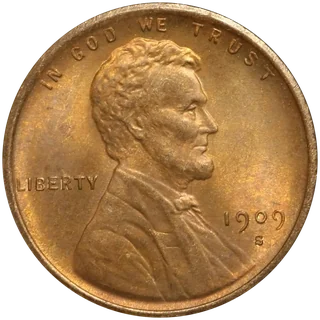
1909-S VDB
The key Lincoln cent: S mint mark plus V.D.B. on the reverse.
Photo: Lost Dutchman Rare Coins, CC BY-SA 3.0 US
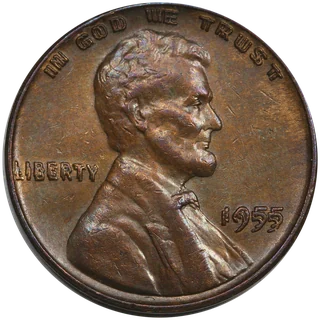
1955 doubled-die obverse
Doubling plain to the eye in the date and legends.
Photo: Lost Dutchman Rare Coins, CC BY-SA 3.0 US
1943 steel cent
Wartime zinc-coated steel, struck to save copper.
Photo: Smithsonian NNC, public domain


Photos are of specific coins from public-domain and openly licensed sources; no grade is implied. Sources and licenses
Penny questions, answered straight.
Did the U.S. really stop making pennies?
Yes. The Treasury halted penny production in 2025 to cut costs (each cent cost roughly 3–4 cents to make), and the final circulating cents were struck at the Philadelphia Mint on November 12, 2025. Pennies remain legal tender — there are roughly a quarter-trillion still out there — but no new ones are being made for circulation, which is exactly why collector interest has spiked.
Are my pre-1982 copper pennies worth melting?
They contain about 4 cents of copper at mid-2026 prices, but melting U.S. pennies is a federal crime (31 CFR Part 82), with penalties up to $10,000 and five years in prison. The play is to hold or sell bulk copper cents to collectors and speculators by the pound — never to melt. Use our copper jar calculator for the numbers.
Should I clean my pennies before selling?
Never. Cleaning leaves microscopic hairlines that collectors and grading services spot instantly, and it can cut a coin’s value by 50–90%. A naturally toned, dirty original coin is always worth more than a shiny cleaned one.
How do I know if my 1943 copper penny is real?
Two quick tests: a genuine 1943 bronze cent does not stick to a magnet and weighs about 3.11 g (steel cents weigh 2.7 g). Most “copper” 1943s are copper-plated steel novelties or altered 1948s. If yours passes both tests, stop handling it and submit it to PCGS or NGC — genuine examples have sold for $100,000 to over $800,000.
Where’s the best place to sell a valuable penny?
Depends on value. Under ~$100: eBay or a local coin shop (get two quotes). $100–$500: eBay with strong photos, or a dealer. Over $500: get it certified by PCGS/NGC first, then consign to a major auction house (Heritage, GreatCollections, Stack’s Bowers) — their buyer pool routinely outbids retail by more than their fee. We can route this for you via the appraisal service.
How much does professional grading cost — and when is it worth it?
PCGS and NGC charge roughly $30–$50 per coin at standard tiers, plus shipping. Our rule of thumb: grade a coin when its conservative value estimate tops ~$150, or whenever authenticity is the question (all 1943 bronze / 1944 steel / 1969-S DDO candidates). Below that, the fee eats the upside — sell raw.
What’s a mint mark and where is it?
A small letter under the date on the front: S for San Francisco, D for Denver, none for Philadelphia (Philadelphia used no mint mark on cents in most years; 2017 cents carry a one-year “P”). Low-mintage branch-mint years — like 1909-S, 1914-D, and 1931-S — are where the money is.
Are 2025 pennies a good investment?
They’re a fun hold, not an investment. Final-year cents were minted in the billions, so scarcity is generations away. Uncirculated rolls carry a modest premium today. Buy what you enjoy; put real money into certified key dates with decades of price history — and remember all coin values can fall as well as rise.
Are your values guaranteed?
No — they’re good-faith market estimates from recent price guides and auction data, and real value always depends on grade and authenticity. We’re not a grading service; for certification we route coins to PCGS or NGC, the industry’s two independent authorities.